
In the agricultural and industrial sectors, potassium nitrate serves as a highly efficient, chlorine-free potassium fertilizer and an important raw material; its quality directly impacts crop absorption and production efficiency. Although many products on the market are labeled “13.5-0-46,” their prices vary significantly. Take Sichuan Yusheng Xingtai Chemical Co., Ltd. as an example: why does its potassium nitrate stand out among so many brands and earn the continued trust of high-end customers?
The answer lies in the production process. Two processes, two levels of quality.
Currently, there are two main production routes for potassium nitrate in China:
❶ Double decomposition + secondary recrystallization (ammonium nitrate method)
Reaction equation: NH₄NO₃ + KCl → KNO₃ + NH₄Cl
Core steps: Cooling and crystallization → Separation → Secondary recrystallization for purification
❷ Magnesium nitrate method (single-stage crystallization)
Reaction equation: Mg(NO₃)₂ + 2KCl → 2KNO₃ + MgCl₂
Core steps: Single-stage crystallization → Drying and grinding
Why is Yusheng Xingtai willing to “go the extra mile”?
Secondary recrystallization is the cornerstone of our process. Although it entails:
Higher energy consumption (steam, cooling water)
- Stricter raw material selection (refined potassium chloride, high-purity ammonium nitrate)
- Higher water quality requirements (softened water/deionized water)
- Longer production cycles
Yet each of these steps is taken to ensure:
- Greater purity: Cl⁻ content below the national standard for premium-grade products
- Greater usability: Uniform crystals with good flowability that do not clog drip irrigation emitters
- Greater safety: Controlled heavy-metal levels documented by batch COAs, suitable for high-standard agriculture
- Greater stability: Resistant to moisture absorption and designed to remain free-flowing during storage.
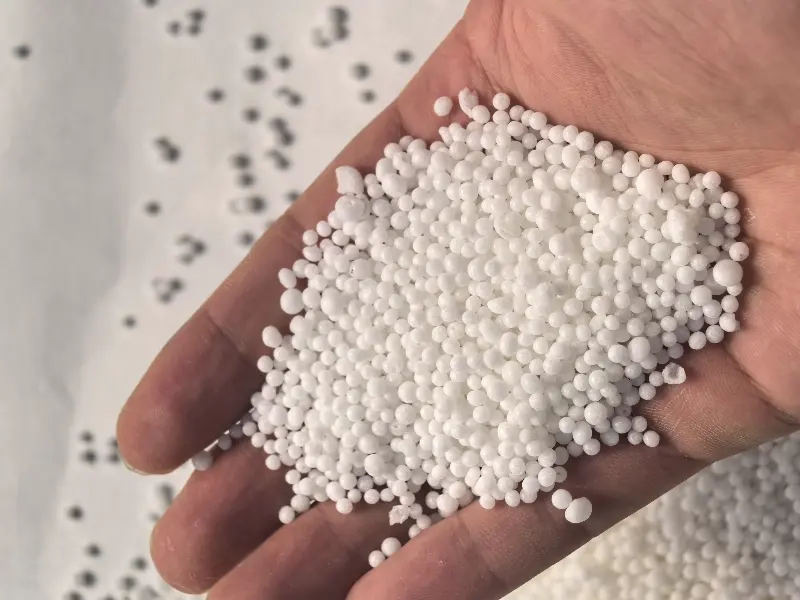
Yusheng Xingtai employs the double decomposition method, which produces ammonium chloride as a byproduct. This byproduct can be directly utilized as a high-quality nitrogen fertilizer, enabling a circular production process.
In contrast, the byproduct of the nitro-magnesium process is magnesium chloride, which has limited applications, is prone to deliquescence, and is difficult to handle, often becoming an environmental burden. The process we have chosen is inherently eco-friendly from the very beginning.
In Agricultural and Industrial Applications
Agriculture: Potassium nitrate produced by the ammonium nitrate process is known as the “perfect partner for drip irrigation systems.” Its crystals are as pure as water, and when dissolved, the solution is as clear as spring water, which can help reduce the risk of impurities clogging precision drippers when water quality and operating conditions are properly managed. Its ultra-low chloride ion content (<0.1%) means it can be safely used on the most delicate cash crops, such as fruits, tobacco, and vegetables, with low chloride levels, subject to the product specification and application conditions. Its uniform crystal structure and extremely low hygroscopicity ensure that it remains as loose as ever even after long-term storage, allowing for precise and error-free application. In contrast, products made via the magnesium nitrate process often become cloudy upon dissolution; residual magnesium and calcium ions may disrupt nutrient balance. Their higher hygroscopicity not only leads to caking and wastage during storage, but fluctuations in chloride ion levels also pose a potential threat to sensitive crops.
Industry: Products made via the ammonium nitrate process are the “invisible cornerstone” of high-end manufacturing. With ultra-high purity exceeding 99.5%, it serves as an irreplaceable raw material in glass clarification, specialty explosives formulation, and high-end food processing. Extremely low levels of metal impurities (such as calcium, magnesium, and iron) ensure that it does not introduce contaminants that could cause product defects in heat treatment salt baths used in the precision electronics industry, supporting process stability and high yield rates for finished products. Its uniform physical form and stable chemical properties provide predictable and reliable performance guarantees for demanding industrial production. In contrast, products made via the magnesium nitrate process, due to their limited purity and significant fluctuations in impurities, are typically only suitable for general industrial applications with higher quality tolerance thresholds and are unable to meet the stringent requirements of core high-end sectors.
Quality Lies in the Invisible Details
Potassium nitrate may look similar on the surface, but purity, impurities, solubility, and stability are the true distinguishing factors. Yusheng Xingtai is committed to using more complex processes and incurring higher costs to produce cleaner, safer, and more effective potassium nitrate.
We believe that true value lies not in the price tag, but in what stands behind every crystal—our responsibility to the land, our respect for crops, and our sincere investment in the future of agriculture.